
USFans Spreadsheet Women: Keep Your Fit Requirements with Every Find
When browsing a USFans spreadsheet for women, make the saved item answer a specific clothing need. A category label does not tell you the garment's proportions, available sizes or how it fits your intended outfit. Keep those requirements beside the exact option so they remain visible when you compare another find.
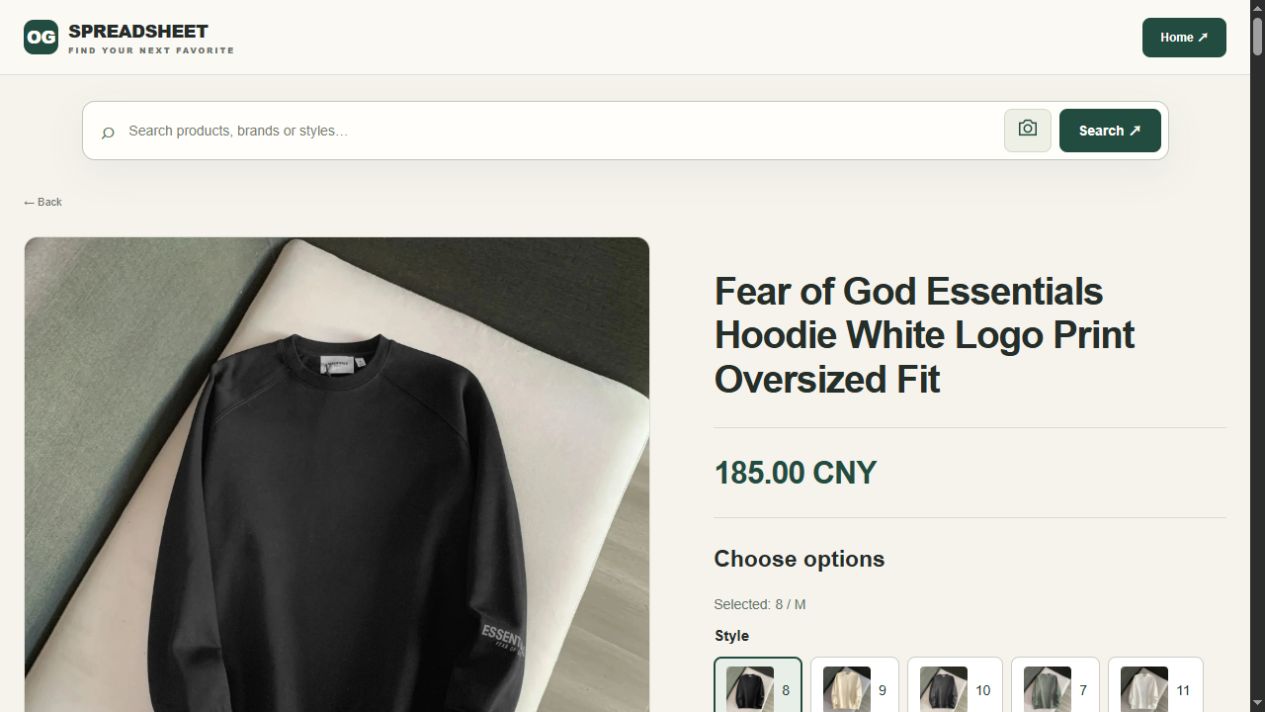
For an upper layer to investigate, view the Essentials-labelled candidate on USFans. Style 8 / M showed a black crewneck on 1 October 2026. Compare its actual measurements and neckline with your planned layers; neither the broad hoodie heading nor shortlist placement establishes a women-specific cut.
Start with the constraint that previous purchases missed
Think of a garment you own and what you would change for this purchase. Perhaps its body length works but the sleeves are too long for your preference, or its shoulders suit you but it lacks the room you want for a layer underneath. Describe the difference rather than translating it immediately into a larger or smaller label.
For a hypothetical example, you want the body length of your current top with more room around the upper arm. Moving up a size might change several dimensions at once. Identify which candidate measurements are available and ask about the missing one that matters; do not assume a size change preserves the length you already like.
The size guide helps compare consistent garment measurements rather than mixing them with body measurements or unexplained chart figures.
Give each candidate a short requirements card
Keep the product destination, selected option and applicable chart together using the spreadsheet links guide. Then record the condition that would make the candidate useful to you.
| Requirement | Information to compare | Decision to avoid |
|---|---|---|
| A particular top length | Defined body length against a relevant garment | Assuming the model's pose shows your result |
| Room for an intended layer | Relevant garment dimensions and construction | Adding an arbitrary amount to a size label |
| A preferred trouser silhouette | Defined waist, rise and leg information | Choosing from the waist label alone |
| A coordinated outfit | Included pieces and sizing for each | Assuming one size works equally for every piece |
Use the T-shirt guide, pants and shorts guide or sets guide for the corresponding comparison. Those pages address different garment questions rather than treating women's clothing as one universal fit system.
Do not let styling replace the selected option
A photograph may show a garment tucked in, layered or arranged in a way that hides its full shape. Use it for the visible styling idea, then establish the actual item dimensions and design details independently. Retain the selected colour and size rather than merging attractive views from different options.
A garment listed in another category can still be considered if its actual information suits your requirements. But do not infer that it has a certain cut merely because someone styled it that way. Equally, a women's category label cannot establish that its size matches another brand or model.
For jackets or longer layers, the jacket guide helps identify which views and measurements address the intended choice. A close-up of a decorative detail cannot answer a question about the full back length.
Assess the actual garment when it becomes available
Compare the warehouse record with the saved option before judging visible details. If a measurement is needed, ask whether it can be supplied with clear endpoints and units. A photograph of a size label does not replace a measurement of the area you are investigating.
If the garment appears different from the order, describe the exact discrepancy. The QC photo guide helps separate visible observations from assumptions about comfort, composition or wear. The returns guide explains how to organise the remedy request without assuming acceptance.
Product-only measurements and images can support these comparisons. You do not need to provide identifying body photographs to build a useful public example. Keep personal information out of shared records and retain private order details only where required for the actual support case.
Read reviews for the question you still have
A review is most useful when the actual option and observation are clear. Someone liking a garment's appearance does not establish its measurements; a successful delivery does not prove that it fits your requirements. Use the review guide to keep those observations separate.
If a reviewer compares the item with another garment, check whether that comparison helps answer your own question. Do not turn a general instruction to size up or down into a rule across unrelated finds.
Compare the purchase after the fit questions
When a candidate meets the information requirements for the next step, compare the selected price and the later parcel proposal separately. A garment is not a better fit because its shipping estimate is lower. Nor does a low product price establish the complete delivered cost.
The shipping guide explains the parcel side of the decision. Use the best spreadsheet guide to keep your shortlist organised: selected option, answered question and any remaining uncertainty are more useful than a collection marked only with favourite symbols.
Frequently asked questions
Are USFans women spreadsheet sizes interchangeable?
No. Compare the applicable dimensions and measuring definitions for the actual selected garment. Category labels and familiar size letters do not supply that comparison.
Does the linked hoodie establish a women's fit?
No. It is a garment reference to investigate using its actual option information and your requirements, not a tested fit recommendation.
Should I choose a larger size whenever one dimension is unclear?
Clarify the relevant dimension first. Changing the label can alter more than the feature you wanted to change.
Can styling photographs replace measurements?
No. They may suggest an outfit, but do not establish how the selected garment's dimensions compare with your reference.