
USFans Essentials, Hoodies and Sweaters: Keep the Garment You Want in Focus
Searching for USFans Essentials or Nike Tech can produce references to different garments, options and combinations. Before comparing prices, write down the piece you actually want: a hooded top, a zip-front layer, a crewneck or a complete matching outfit. A recognisable name does not settle which item is included.
For a concrete option comparison, view the Essentials-labelled layer on USFans. Style 8 / M showed a black crewneck on 1 October 2026 while the title still described a hoodie. Save that neckline with the size; a general model name does not make it a hooded top or a Nike Tech result.
Separate the named search from the garment requirement
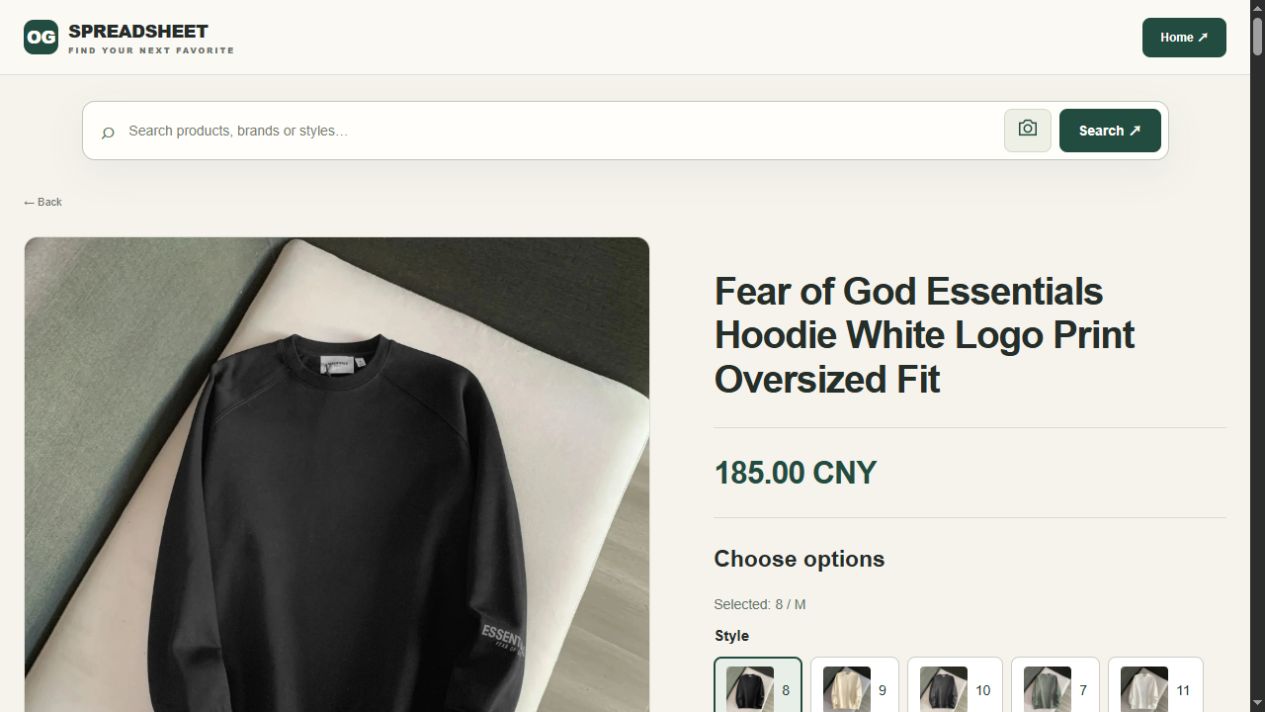
Keep two short notes for a candidate. The first records the exact product and option wording. The second records why you want it. If the reason is a zip opening, a similarly coloured pullover does not meet the same requirement. If you want a complete outfit, a top photographed with matching trousers is not enough to establish that both are sold together.
For USFans Nike Tech searches, identify the piece and selected option rather than treating the name as one universal outfit. For USFans Essentials searches, retain the actual garment description rather than assuming every reference has the same cut or construction. Use the spreadsheet links guide to keep that identity with its destination.
If matching pieces are the objective, the sets guide addresses the included-item question. Do not add a second piece merely to recreate a styled photograph without checking its separate selection and cost.
Map the opening, sleeves and hem before choosing a size
A larger label is not a precise instruction about how a garment will sit. Compare the dimensions that matter to the way you intend to use it, using the same measurement definitions as your reference garment.
Imagine a hypothetical shortlist for a top you plan to wear open over a T-shirt. One candidate has a full front opening; another only resembles it when laid flat but is a pullover. Before spending time comparing their chest widths, remove the one that does not meet the opening requirement. This is a feature decision, not a claim that one construction is better.
Then compare the remaining candidate's body length, sleeve information and hem description. If the chart omits a dimension that would change your choice, ask for it rather than assuming it follows from another value. The size guide explains why flat garment measurements and body measurements should stay distinct.
| Intended choice | Detail to establish | Insufficient substitute |
|---|---|---|
| A front-opening layer | The actual closure and selected design | A fold that looks like an opening |
| A hooded top | Whether the selected garment includes the hood | A hood shown only on another gallery option |
| A matched outfit | Which pieces and sizes the purchase includes | Trousers used to style the photograph |
| A crewneck to wear under another layer | Relevant neckline, body and sleeve dimensions | A shared size letter across two garments |
Use views that answer the construction question
When the candidate reaches the warehouse, match the visible item to the selected option. If a closure matters, a folded garment may hide the feature you need to examine. Ask whether a suitable view or check is available and what it includes. Do not assume that a photograph proves the closure works smoothly.
For a suspected loose thread or uneven detail, retain a contextual view identifying the location. A close image without the wider garment can make it difficult to distinguish the affected area from a different item. The QC guide helps turn an impression into a question that a relevant view can answer.
Visible correspondence is still different from long-term performance. A clean photograph does not establish resistance to pilling, stretch recovery or durability after washing. Keep those questions attached to relevant product information or clearly bounded wearer observations, rather than turning appearance into a test result.
Do not translate a texture into a specification
Ribbing, a brushed-looking surface or a thick-looking fold describes what an image appears to show. None supplies an exact fibre composition or garment weight. Read the selected item's description and any corresponding label information. If they disagree, clarify the discrepancy before building a purchase decision around one version.
Likewise, avoid assigning a temperature rating from a photograph or a generic word such as “winter.” This guide does not establish thermal performance for the referenced pullover or any named brand search. The review guide explains how to distinguish a person's experience with one garment from a claim applying to every item with a similar name.
Resolve item questions before compressing the parcel decision
If a hoodie or sweater appears to be the wrong option, handle that question before authorising changes intended to prepare the parcel. Check whether removing tags or packaging affects the remedy being considered. The returns guide separates the request, acceptance and resulting money record.
Once you are keeping the item, compare the actual packing proposal. A bulky-looking garment is not a measured parcel, and a packaging change is not automatically a shipping saving. Use the shipping calculator guide to keep dimensions, weight and the selected route's calculation separate.
For a broader outfit, compare the adjoining T-shirt or jacket as its own purchase. A compatible colour is not confirmation that the measurements or included pieces match your plan.
Frequently asked questions
Is every Essentials reference the same garment?
Do not assume so. Preserve the actual product wording, selected option and corresponding measurements. A name alone does not establish identity or authenticity.
Does a Nike Tech photograph show what I receive?
Check the selected option and included-item description. A styled photograph may show more than the item being purchased.
Can I use a crewneck instead of a hoodie?
Only if it meets your own requirement. The linked candidate is a hoodie; if you specifically need a hood-free neckline, compare a separate crewneck rather than assuming the two garments serve the same layering purpose.
Can inspection photos establish warmth or washing results?
No. They can help with the visible details actually shown. Use applicable product information and bounded experience for questions beyond those views.